
Author: Ilaria Geddes, Research Fellow, Society and Urban Form (SURF) Research Lab, University of Cyprus.
We started a new project: Twinning Towards Research Excellence in Evidence-Based Planning and Urban Design. It is a project that wants to build capacity in EBDP to enhance scientific competence of this field at the University of Cyprus, the project’s coordinator, and to foster its practice in Cyprus.
When I first started learning about evidence-based design and planning some 20 years ago in the UK it immediately struck me as the obvious thing to do: making decisions based on the most reliable research evidence. Why? Because by assisting planning and design with analytical methods, it helps achieve the best possible outcomes and it reduces the risk of failure. Failure in the built environment has long-lasting social and environmental impacts; once something is built it is difficult and costly to fix. As we strive to transition our cities to more sustainable and just environments we need knowledge and tools to assess the potential impact of design and planning decisions before they are implemented. EBDP enables the evaluation of design ideas led by intuition to determine empirically whether they are the right solution.
Twenty years on and now ten months into this project, we need to address some fundamental questions. Back then ‘big data’ was in its infancy and EBDP was practiced by a handful of designers or consultants, often having to make their case to peers, developers or granting authorities. While its practice, and demand for it, has become more common, especially in countries with stronger research cultures and more developed planning systems, it certainly hasn’t yet become mainstream. There are many reasons for this, ranging from the extent to which it is embedded in education, lack of regulatory frameworks, design and planning cultures, and so on. Perhaps we will treat this specific topic in another article; here I want to focus on some of the related fundamental questions we have discussed in this project so far:
- There have been historic missteps in the application of ‘evidence’ in the design process, in particular in the age of modern planning, leading to: a disregard for context, separation of functions, lack of human scale, disruption of the urban fabric, social exclusion and lack of sustainability. Perhaps unexpectedly, analytical thinking based on evidence was sparked by civil movements (most famously Jane Jacobs) and supported by scientific approaches rather than the other way around. When it comes to planning and design, there may not be an ideal solution or even a consensus on what we want to achieve. EBDP can tell us what might happen if we make a certain decision; how we want our cities to be is a different question.
- There is a difference between research, evidence-based design, research-informed design, and data-driven design. In research, we test one hypothesis by using an appropriate methodology. Research-informed design examines the findings from specific research and broadly applies them to the decision-making process, while data-driven design utilizes data and analytics to guide the design process with the goal of creating a single optimized output. Evidence-based design is different because it applies a broad range of information and methods in a focused manner to inform the overall design and planning process (the difference between research-informed and evidence-based was well defined by Peavey et al. 2017, whose diagram is shown here below). The process remains led by the practitioners, while EBDP provides an assessment of different output options. Which output we ultimately pick and for what reason, again is a different question.
- What is actually evidence? This is a question that we have discussed a lot. As more and more data become easily available and participatory practices become more widespread, we need to take stock that there are different types and levels of evidence, ranging from the most subjective (e.g. the insight of people using a building or a public space) to the most objective (e.g. meta-analysis and systematic reviews of experimental studies) with plenty in between (e.g. site analysis, consultant expertise, peer reviewed literature, etc.). All of these have their value and their application; what EBDP does is to select relevant evidence, critically interpret it by assessing its quality and strength to then perform analysis and explore different options for evaluation based on the evidence.
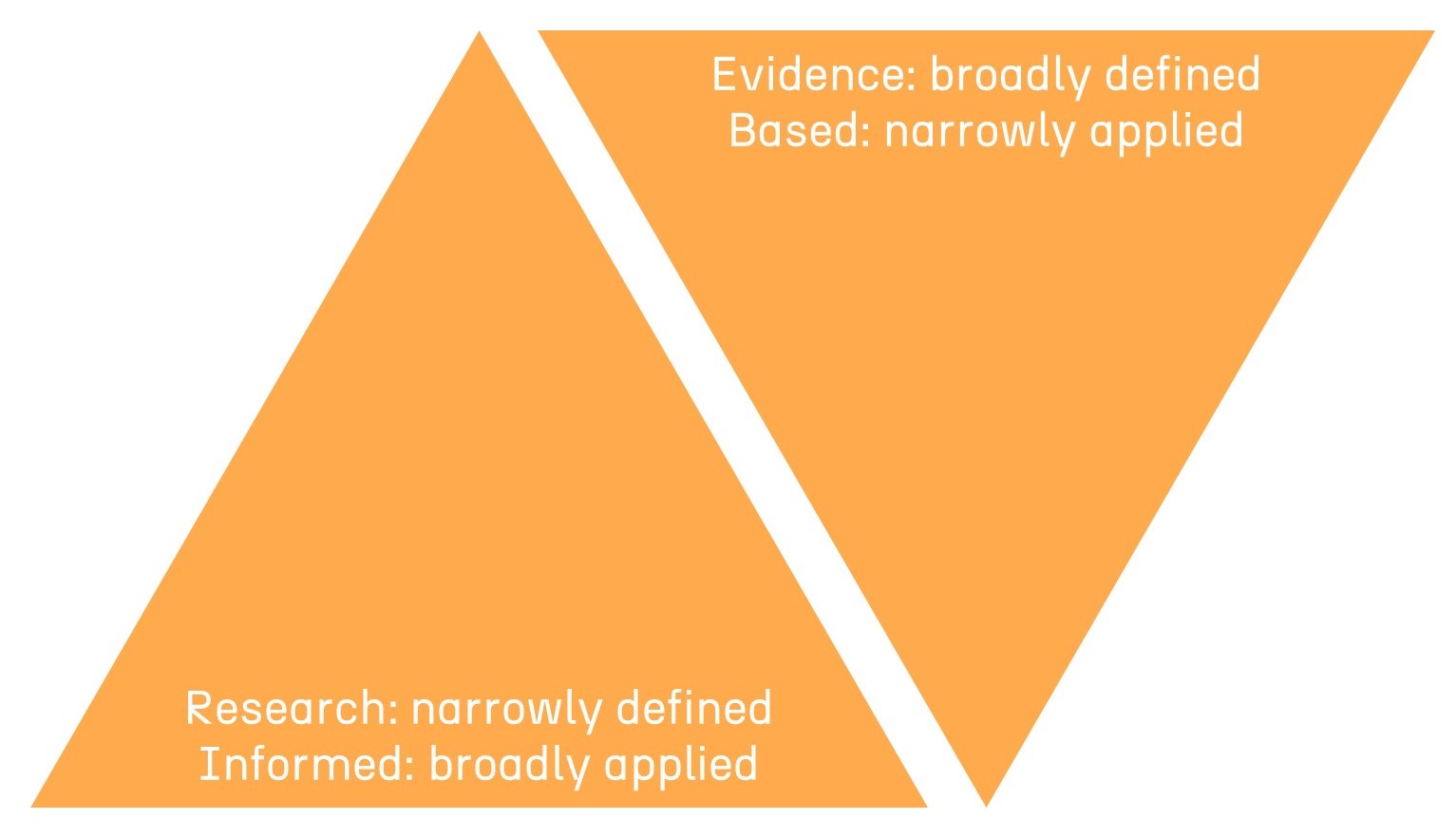
So, while I am still convinced that evidence-based design is the obvious thing to do, it is certainly more complex to perform and to explain how it is properly done than it might at first seem. It is not necessarily obvious to those who have spent much of their professional life applying traditional planning and design processes. Evidence-based design is an iterative process, which not only performs baseline analysis before the design generation phase, but also uses spatial analysis and composite analytical models to produce design ideas and evaluate multiple design options, feeding back into the design generation process.
One thing that has become clear in the last few months is that there is enormous interest in this field and enthusiasm to learn about it. The feedback from presentations of our preliminary work on the state-of-the-art of EBDP, given at the AESOP2023 Congress and the ISUF2023 Conference, is that a clearer definition of EBDP, means to evaluate the strength of evidence, and a framework for applying it, are needed. Interest in its application here in Cyprus, especially from design practitioners, planning and real estate consultants during our first stakeholder meetings, has surpassed our expectations. It gives me great motivation to continue making the case for it.
Note: ‘We’ are the Department of Architecture of the University of Cyprus, the Bartlett School of Architecture of University College London, The Spatial Morphology Group of Chalmers University of Technology, the Polytechnic University of Turin, and Space Syntax Limited.
The TWIN2EXPAND Project is funded by the European Union under grant agreement 101078890 and by the UKRI under grant numbers 10052856 and 10050784. Views and opinions expressed are those of the author(s) only and do not necessarily reflect those of the European Union or the European Research Executive Agency (REA). Neither the European Union nor the granting authority can be held responsible for them.
