
Authors: Marco Trisciuoglio, Full Professor, Department of Architecture and Design, Politecnico di Torino; Martina Crapolicchio, Post-Doctoral Research Fellow, Department of Architecture and Design, Politecnico di Torino.
How can small research laboratories in peripheral contexts become globally relevant actors in the production of urban knowledge? This was one of the central questions addressed in the framework of the TWIN2EXPAND project, aiming to enhance institutional capacities in Evidence-Based Design and Planning (EBDP) in Cyprus and, in particular at the University of Cyprus through the Society and Urban Form Research Lab (SURF).
As part of TWIN2EXPAND, the Politecnico di Torino (POLITO) team was tasked with supporting the strategic repositioning of the SURF Lab (Society and Urban Form Research Lab) at the University of Cyprus (UCY). The emergence of EBDP [1] places evidence, participation, and interdisciplinarity at the heart of spatial design. However, implementing EBDP requires more than new tools: it demands new institutional models, research ecosystems, and governance strategies. For emerging labs like SURF, this means creating the conditions to become hubs of experimentation and transnational relevance. The goal: to define a long-term vision and operational roadmap capable of strengthening SURF’s role as a regional and international actor in EBDP and urban form research.
Mapping Internal Potential: A SWOT Analysis of SURF Lab
The first step toward strategic growth was introspective: a SWOT analysis was conducted to identify the internal and external factors shaping the Lab’s current positioning and future potential.
The analysis revealed that SURF’s small size and flexible structure are significant assets. They allow it to quickly adapt and form interdisciplinary collaborations across UCY, particularly with departments of social sciences, computing, and business. The Lab is well rooted in local urban agendas, with trusted relationships with municipalities and stakeholders, particularly in Cyprus and the EMME (East Mediterranean Middle East) region. These partnerships serve as both a testing ground and a platform for future expansion.
However, the analysis also highlighted some weaknesses. The Lab currently lacks an articulated mission and long-term vision and suffers from limited institutional support. Most projects remain locally focused, constraining visibility and international competitiveness. Additionally, administrative demands and limited staff resources inhibit the development of research innovation and strategic planning.
Despite these challenges, the SWOT analysis emphasised the Lab’s high potential for international growth, especially by leveraging its regional embeddedness to respond to broader urban challenges, from climate adaptation to digital urbanism. The need for a strategic repositioning was clear.
Learning from the Field: Benchmarking Urban Research Labs as a Strategic Tool
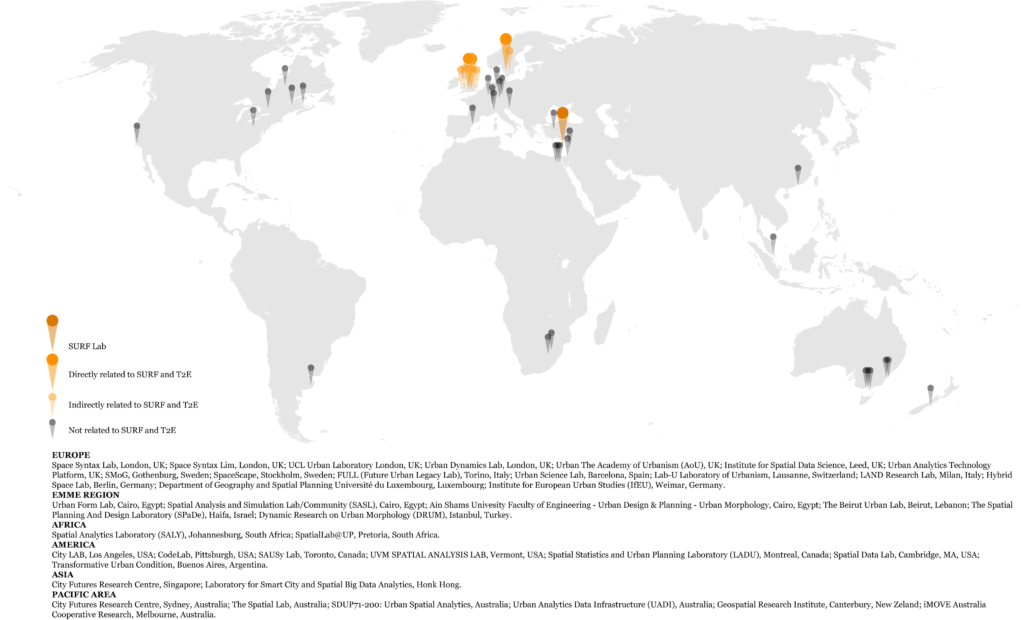
To move from diagnosis to design, POLITO developed a benchmarking study of over 40 international urban research labs. The objective was not just to compare structures, but to understand the institutional models, research strategies, and operational cultures that drive excellence in urban and spatial research today.
This benchmarking effort was methodologically rigorous. It began with the identification of relevant urban labs based on a set of keywords, such as “urban,” “design,” “form,” “evidence,” “stakeholder,” and “innovation,” to ensure thematic relevance to the SURF Lab’s focus on Urban Morphology and Evidence-Based Design and Planning (EBDP). Each lab was analysed through desk research, including review of institutional websites, publications, project portfolios, governance models, and stakeholder engagement.
To bring structure to the analysis, POLITO developed a taxonomy of eight thematic domains, ranging from “Urban Design and Architecture” to “Technological Innovation,” “Policy and Governance,” and “Urban Dynamics and Processes.” Each lab was categorised based on how its research focus and outputs aligned with these domains. Additionally, over 20 keywords were extracted per lab and clustered into a synoptic table, providing a visual matrix of thematic alignment.
The benchmarking also included a qualitative evaluation of four transversal dimensions: stakeholder engagement, target audiences, types of outputs (e.g., tools, reports, training), and institutional structure (academic unit, consultancy, not-for-profit, etc.). This added an operational layer to the analysis, revealing not just what labs research, but how they function in their ecosystem.
Among the labs studied were established centres such as the Space Syntax Laboratory, Spatial Morphology Group (SMoG), Future Cities Laboratory (ETH Singapore), and the Beirut Urban Lab (Fig. 1). Despite their diversity, several converging patterns emerged:
- Leading labs adopt transdisciplinary approaches, combining spatial design with social science, data analytics, and policy research.
- Urban Living Labs (ULLs) and co-creation platforms are common, offering frameworks for participation and iterative prototyping [2].
- Excellence correlates with strong digital infrastructures (e.g., GIS, AI, spatial modelling), access to spatial data platforms, and a clear alignment with global agendas, such as the SDGs, climate resilience, and inclusive governance.
This comparative mapping provided SURF with a concrete framework for identifying its current position, areas for growth, and how to position itself within both the regional and global research ecosystems.
Building the Strategy: From Reflection to Action
Based on the combined results of the SWOT analysis and international benchmarking study, the POLITO team developed a multi-layered strategic roadmap for the SURF Lab. This roadmap transforms diagnostic insights into concrete actions across operational, organisational, and research dimensions.
The strategy recognises that enhancing research capacity in EBDP cannot be achieved through incremental growth alone. Instead, it requires a fundamental rethinking of the lab’s structure, tools, and identity, anchored in the evolving role of Spatial Labs worldwide. The SURF Lab is thus envisioned not merely as a research group but as a transnational platform for experimentation, data infrastructure, and interdisciplinary collaboration.
The SURF Lab’s strategic roadmap envisions a phased development from local consolidation to global leadership. In the short term (0–3 years), the priority is to build strong foundations by finalising governance structures, defining a clear mission, recruiting staff, establishing digital infrastructure, launching pilot projects in Cyprus and the EMME region, and enhancing visibility through communication and funding initiatives. In the mid-term (4–6 years), the Lab will broaden its research portfolio into fields such as AI-driven modelling, climate resilience, and health-oriented analytics, organise international events, form thematic clusters, strengthen partnerships with municipalities, NGOs, academia, and industry, and engage citizens through participatory programmes. In the long term (7–10 years), the goal is to position SURF as a globally recognised Centre of Excellence in sustainable urban governance and EBDP by creating regional nodes across the EMME, diversifying funding, establishing a centralised data and knowledge hub, launching advanced educational programmes, and producing influential policy-oriented outputs that bridge research and practice.
At the heart of this transformation is the proposed creation of a SURF Living Lab, a real-world urban innovation platform where data-driven insights and participatory design converge. The Living Lab will act as a testing ground for spatial interventions, enabling collaborative prototyping, simulation, and iterative evaluation with local communities, decision-makers, and researchers. This model reinforces SURF’s ambition to move beyond the lab and into the city, turning knowledge into action and research into policy.
A Roadmap for Regional Impact and Global Integration
The SURF Lab’s strategy is structured around eight interconnected pillars: scientific vision, organisational strategy, resource allocation, funding support, research management, long-term data infrastructure, advanced tools development, and knowledge transfer. These elements together shape a dynamic and future-oriented laboratory model, capable of addressing urban complexity through data-driven and participatory approaches.
Drawing inspiration from Karin Knorr Cetina’s [3] concept of the laboratory as an epistemic culture, the SURF Lab is envisioned as a space where cities are transformed into analysable, modelled, and experimental objects. By leveraging spatial analytics, GIS platforms, digital twins, and co-creation methods, the Lab brings the city into the lab, generating evidence not only for analysis but for transformation. This methodological shift allows the Lab to function as both an observatory and a catalyst, operating across spatial, institutional, and disciplinary boundaries.
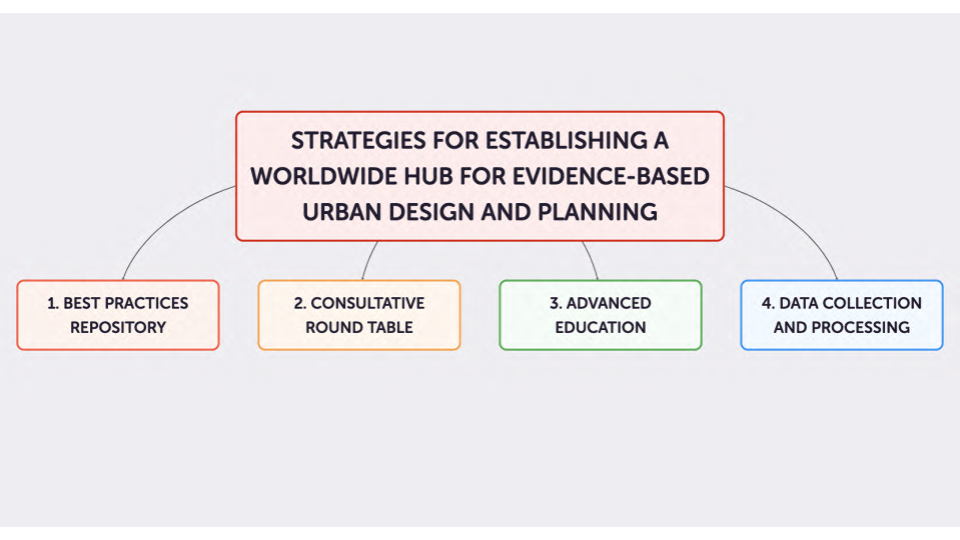
To make this vision operative, the roadmap proposes four strategic macro-actions (Fig. 2):
- Archive – The creation of a global repository of best practices in Evidence-Based Design and Planning (EBDP), offering accessible methods, toolkits, and international case studies.
- Consulting – The activation of interdisciplinary expert panels and virtual roundtables that provide scientific advice and support to complex urban projects across the EMME region and beyond.
- Education – The establishment of a centre for advanced learning, offering degrees, certification programmes, and continuous
- Big Data – The development of a robust and interoperable data infrastructure that enables long-term urban data collection, spatial modelling, and policy-oriented analytics.
Together, these macro-actions reposition the SURF Lab not only as a research centre but as a central hub in the transnational ecosystem of urban knowledge. They provide a coherent foundation for the Lab’s bid to become a Centre of Excellence, one that supports sustainable governance, fosters civic participation, and builds capacity across borders.
By integrating research, education, stakeholder consultation, and open data innovation, the SURF Lab strategy offers a replicable model for institutions seeking to scale up from regional relevance to global leadership in urban transformation.
References
[1] Peavey, Erin, and Kiley B. Vander Wyst. 2017. Evidence-Based Design and Research-Informed Design: What’s the Difference? Conceptual Definitions and Comparative Analysis. HERD 10 (5): 143–56.
[2] Crosson, Courtney (2022) “Four Modes of Engagement: Positioning University Urban Design and Research Centers for the Future,” Journal of Comparative Urban Law and Policy: Vol. 5: Iss. 1, Article 34, 446-465. Available at: https://readingroom.law.gsu.edu/jculp/vol5/iss1/34.
[3] Knorr Cetina, Karin (1999), Epistemic Cultures: How the Sciences Make Knowledge, Cambridge, MA: Harvard University Press.
Disclaimer: The TWIN2EXPAND Project is funded by the European Union under grant agreement 101078890 and by the UKRI under grant numbers 10052856 and 10050784. Views and opinions expressed are those of the author(s) only and do not necessarily reflect those of the European Union or the European Research Executive Agency (REA). Neither the European Union nor the granting authority can be held responsible for them.
