From 5–7 December 2025, the TWIN2EXPAND team participated in the 3rd Conference on Participatory Design, hosted by Participatory Lab at the Agricultural University of Athens. The conference theme—“Spatial Justice in the Era of Climate Crisis: Geographies & Communities of Greece, the Balkans and the Mediterranean”—created a timely space for researchers, practitioners, and community actors to think together about how environmental pressures and socio-spatial inequalities are shaping everyday urban life across the region.
TWIN2EXPAND contributed to these discussions through our work on urban green spaces, accessibility, and inequality, with a focus on the Cypriot context.
Key takeaways:
- Institutional coordination and shared governance: Meaningful participation needs clear structures, roles, and responsibilities. Collaboration among public authorities, experts, civil society, and citizens should be institutionalized to ensure continuity beyond individual projects.
- Participation as a continuous process—not a one-off consultation: Engagement should be embedded across the full planning cycle—problem framing, scenario-building, evaluation, and implementation—so stakeholders can shape decisions, not just respond to them.
- Local knowledge and lived experience matter: Community insights and everyday experiences provide essential evidence about how places function in practice, helping reveal needs, barriers, and inequalities that may be overlooked by top-down approaches.
- Evidence-based participatory design and planning: Stakeholder input is strongest when combined with spatial analysis, accessibility assessment, and scenario evaluation. Integrating community knowledge with reliable data makes trade-offs transparent and supports decisions that are both legitimate and socially just.
These takeaways all point to the same prerequisite: strong institutional coordination and substantive participation. By combining community knowledge with robust scientific evidence, we can plan urban spaces that are genuinely resilient, accessible, and equitable.
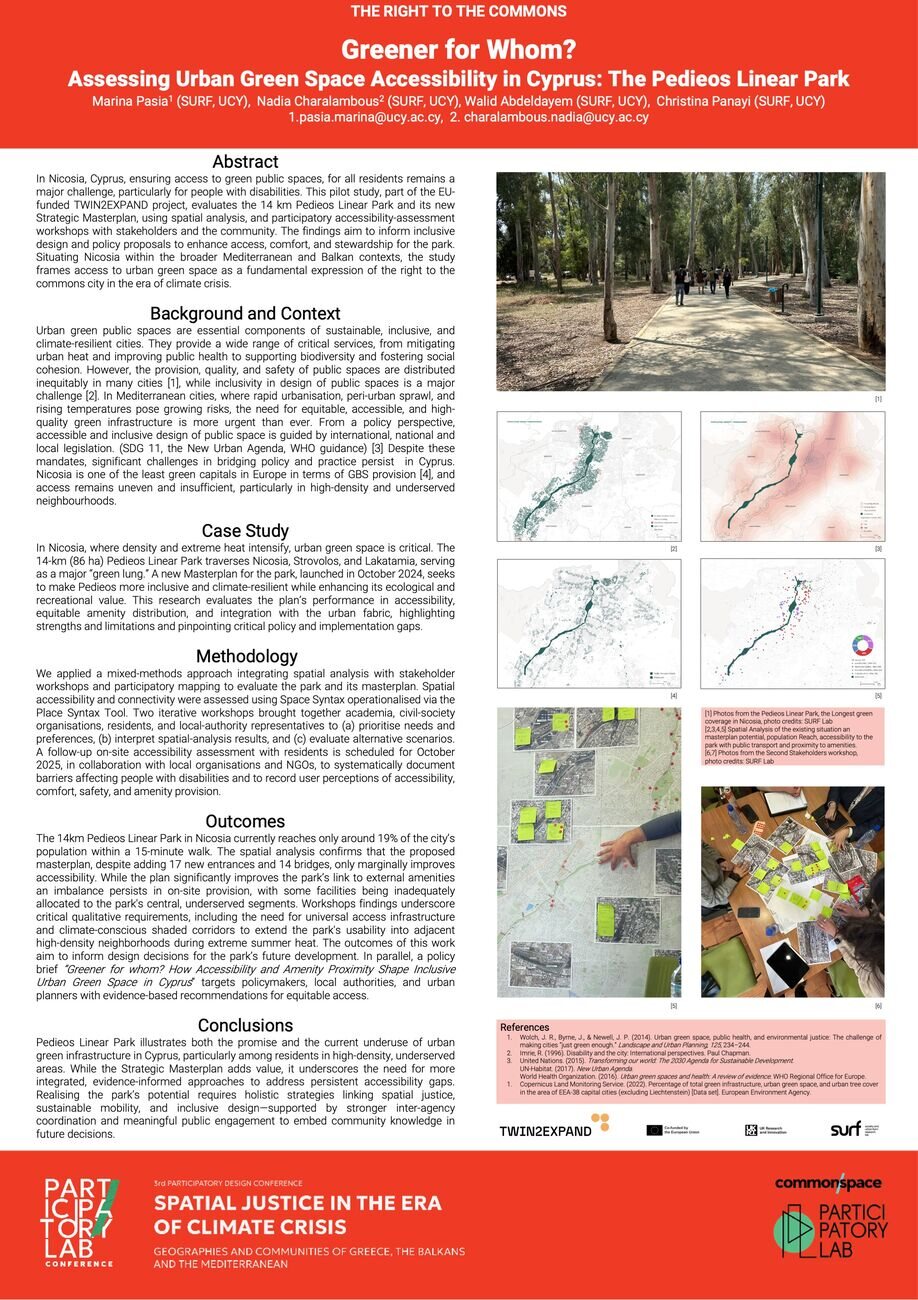
During Session 5, “Urban green: Issues of participation and accessibility,” Marina Pasia presented “Greener for whom? Assessing accessibility of urban green spaces in Cyprus: the case of the Pedieos River Linear Park.” The presentation highlighted work developed within the TWIN2EXPAND project, focusing on the evaluation of the new strategic master plan for the Pedieos Linear Park through participatory methodologies combined with spatial analysis. By focusing on accessibility, this work helps shift the discussion from “how much green exists” to how green is experienced, by whom, and under what constraints.
At Panel Discussion 14, “Morphologies of inequality: urban form, social fabric and the shaping of everyday encounters,” Nadia Charalampous, together with Vinicius M. Netto, Tasos Roidis, and Yannis Paraskevopoulos, examined how urban form and spatial organization influence social relations, everyday interaction, and the production of inequality, linking questions of design and morphology to lived realities. Nadia Charalampous presented the lab’s methodology, Evidence-based participatory design and planning, which combines spatial analysis with stakeholder and community engagment to support evidence-based design and planning.
For TWIN2EXPAND, this conversation connects strongly to ongoing project questions about how urban structure, accessibility patterns, and service distribution shape opportunity and exclusion. Discussions like these are crucial for ensuring that analytical methods and planning tools remain accountable to social realities.
We warmly thank Participatory Lab and Commonspace Coop for organizing the conference, in collaboration with KÆNA, and with support from the @Rosa Luxemburg Foundation. Special thanks to Yannis Paraskevopoulos for the coordination and support. The event offered a strong setting for dialogue and collaboration on spatial justice in the Mediterranean and beyond.
Check the Conference Programme here.