
The TWIN2EXPAND consortium convened online from 15–19 May 2025 for the Working Group Studio, bringing together researchers, practitioners, and policymakers to examine how evidence-based planning and design (EBDP) can better support sustainable urban development. Hosted by the Bartlett School of Architecture (UCL), the event focused on making EBDP methods more communicable, scalable, and operational across diverse planning contexts.
Advancing the Integration of Theory and Practice
Session A addressed the longstanding gap between research and professional application. Discussions emphasised the distinction between data-driven and evidence-based approaches, the importance of contextual engagement, and the challenges of scaling analytical tools such as space syntax. Speakers highlighted validation, knowledge management, and effective communication as essential for translating analytical outputs into actionable planning decisions.
Open Workflows, AI, and Collaborative Tool Development
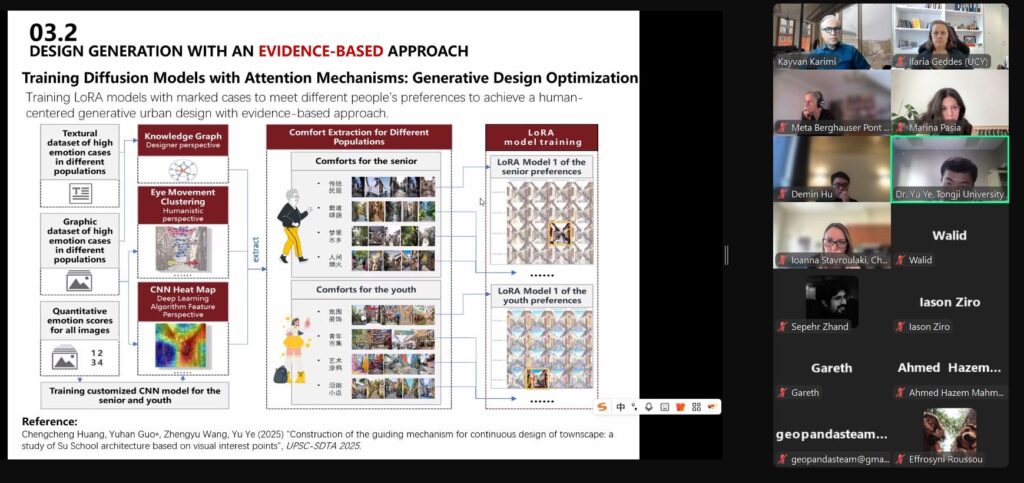
Session B explored how unified tools and workflows can bridge technical and theoretical dimensions of EBDP. Contributions showcased open-source ecosystems, reproducible research practices, and the benefits of “open by default” approaches. Presentations on AI-assisted urban design demonstrated how computational tools can support rapid iteration and collaborative exploration, reinforcing their role as complements to professional expertise rather than replacements.
Consolidation, Dissemination, and Future Directions
Session C focused on consolidating insights from the studio, including discussion of an EBDP conceptual model, coordination of upcoming summer school activities, and strategies for disseminating tools and knowledge. Participants stressed that accessibility, collaboration, and shared infrastructures are critical for expanding the impact of EBDP beyond academia and into policy and practice.
Key Outcomes
Working Group Studio C reinforced the importance of integrating robust evidence, open tools, and collaborative workflows to support resilient and inclusive urban development. By aligning academic research, professional practice, and emerging technologies, the studio contributed to a shared foundation for advancing evidence-based planning and design across international contexts.
